
How to spot bottlenecks in production before they cause delays
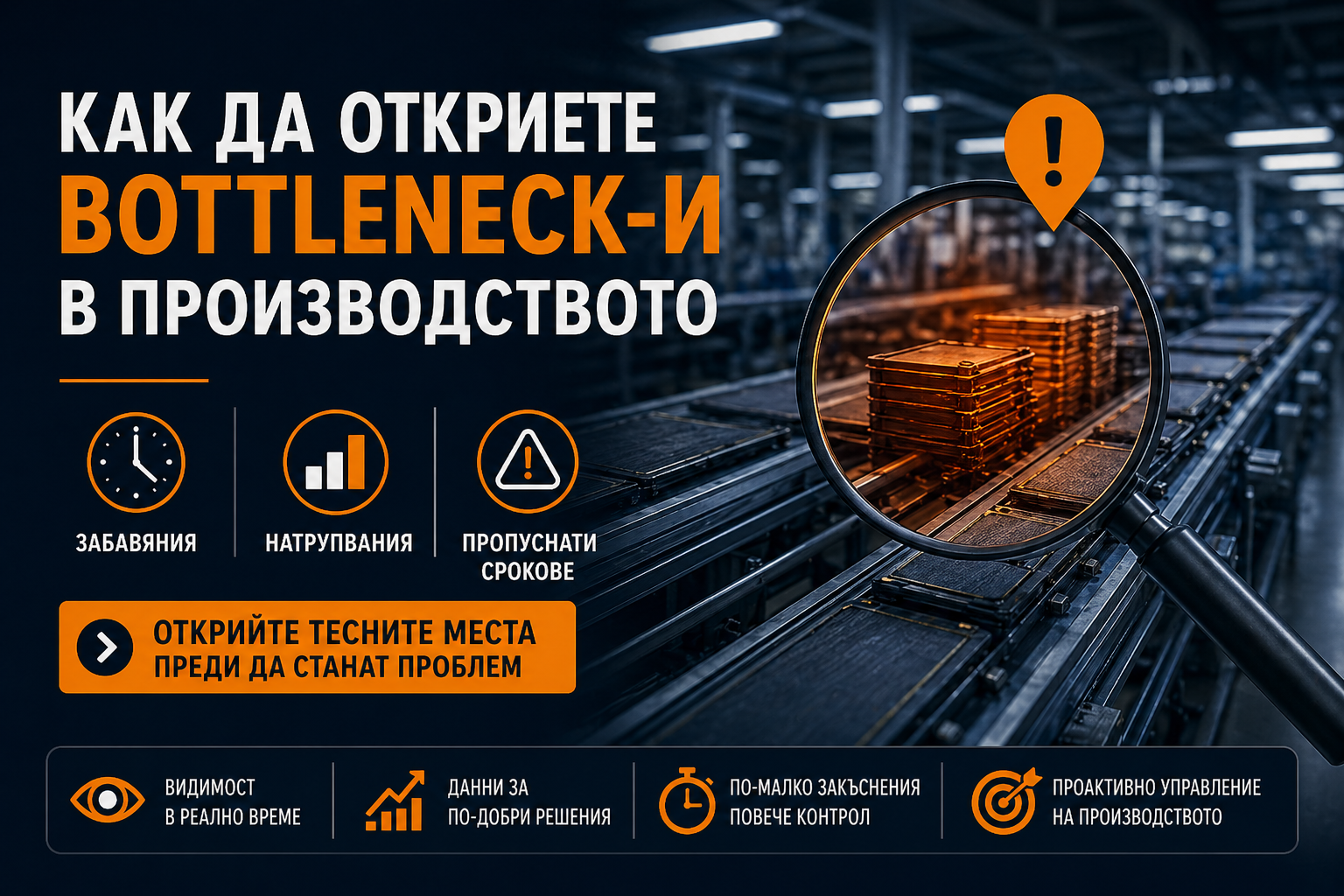
Delays rarely start from big problems
Production delays rarely start from big problems.
Far more often they start from small accumulations — one operation starts falling behind, a work centre gets overloaded, materials wait a little longer than usual.
At first it looks insignificant.
Then come schedule shifts, emergency resequencing, and missed deadlines.
This is often the effect of a bottleneck — a narrow point in the production flow that constrains the whole system.
The good news is that bottlenecks can be spotted early — if you know what to watch.
What is a bottleneck in production?
A bottleneck is an operation, resource, or process that limits the capacity of the entire flow.
If one operation runs slower than the rest, it starts holding back everything downstream.
For example:
- Cutting processes 500 pieces a day
- The sewing line processes 320
- Final inspection can handle 450
Here the constraint is the sewing line.
It does not matter that the other processes have more capacity — production actually moves at the pace of the slowest point.
Why bottlenecks often go unnoticed
Narrow points rarely look like a big problem at first.
More often they look like:
- "normal" delays
- temporary build-ups
- emergency resequencing
- permanently loaded teams
- frequent firefighting
Over time, though, the consequences start showing:
- deadlines drifting
- work piling up between operations
- overloaded work centres
- declining predictability
- constant corrections to the plan
And the cause is often one invisible narrow point.
5 signals that you have a bottleneck
1. Orders consistently stall in the same place
If one operation regularly turns into a queue, that is a signal.
A build-up almost always means a constraint in the flow.
2. Part of the team is overloaded while another waits
If some people are permanently catching up while others wait for incoming work, the flow is not balanced.
That is often a bottleneck.
3. Delays always start at the same operations
When the problem repeats in the same place, it is no longer chance.
It is a systemic signal.
4. Rush orders blow up the entire schedule
If one priority order creates chaos everywhere, you are probably working around a narrow point.
5. Management is permanently reactive
If the day goes into resequencing, corrections, and putting out problems, there is probably a hidden constraint.
How to find bottlenecks in time
Watch where work in progress accumulates
The simplest indicator:
Where does work collect?
Where there is a persistent backlog, there is probably a narrow point.
Measure time per operation
Gut feel is not always an accurate indicator.
Data is.
Track:
- cycle time
- waiting time
- throughput
- time between operations
Many bottlenecks only become visible once you measure.
Watch the load per resource
Sometimes the bottleneck is not a process but:
- a machine
- a person
- capacity
- a material constraint
A permanently overloaded resource is often the problem point.
Analyse the delays that repeat
A one-off problem is an incident.
A repeating problem is a system.
That is exactly what you should be looking for.
Why Excel rarely reveals bottlenecks in time
Excel can help with planning.
But it rarely shows what is happening in real time.
The plan is one thing.
The flow is another.
And bottlenecks appear precisely in the movement of production.
Visibility solves half the problem
Many narrow points do not require complex optimisation.
They simply need to be seen early.
When you have visibility over:
- statuses per operation
- workload
- progress per order
- delays in real time
bottlenecks start surfacing before they turn into a problem.
And then management becomes proactive.
Not reactive.
In closing
Every manufacturer has constraints.
That is normal.
The problem is not that a bottleneck exists.
The problem is finding it only after a deadline has been missed.
The earlier you see the narrow points, the more control you have over the entire production process.
And that is often the difference between an operation that is permanently catching up and one that runs under control.
See how WispTrack plans production — an order queue, real capacity, skills, machines, and weekly schedules.
production planning software →Ready to simplify your production? Book a free demo call.
Book a demo